Achilles Tendinitis Recovery Time: Honest Expectations
The Achilles heals on tendon time, not your calendar. Knowing the real numbers prevents both premature quitting and reinjury.
Read the article →Pain at the back of the heel that stiffens overnight and barks at the start of a run is usually the Achilles tendon asking for help. Answer it early: the Achilles is the strongest tendon in the body, but it heals slowly and punishes neglect.
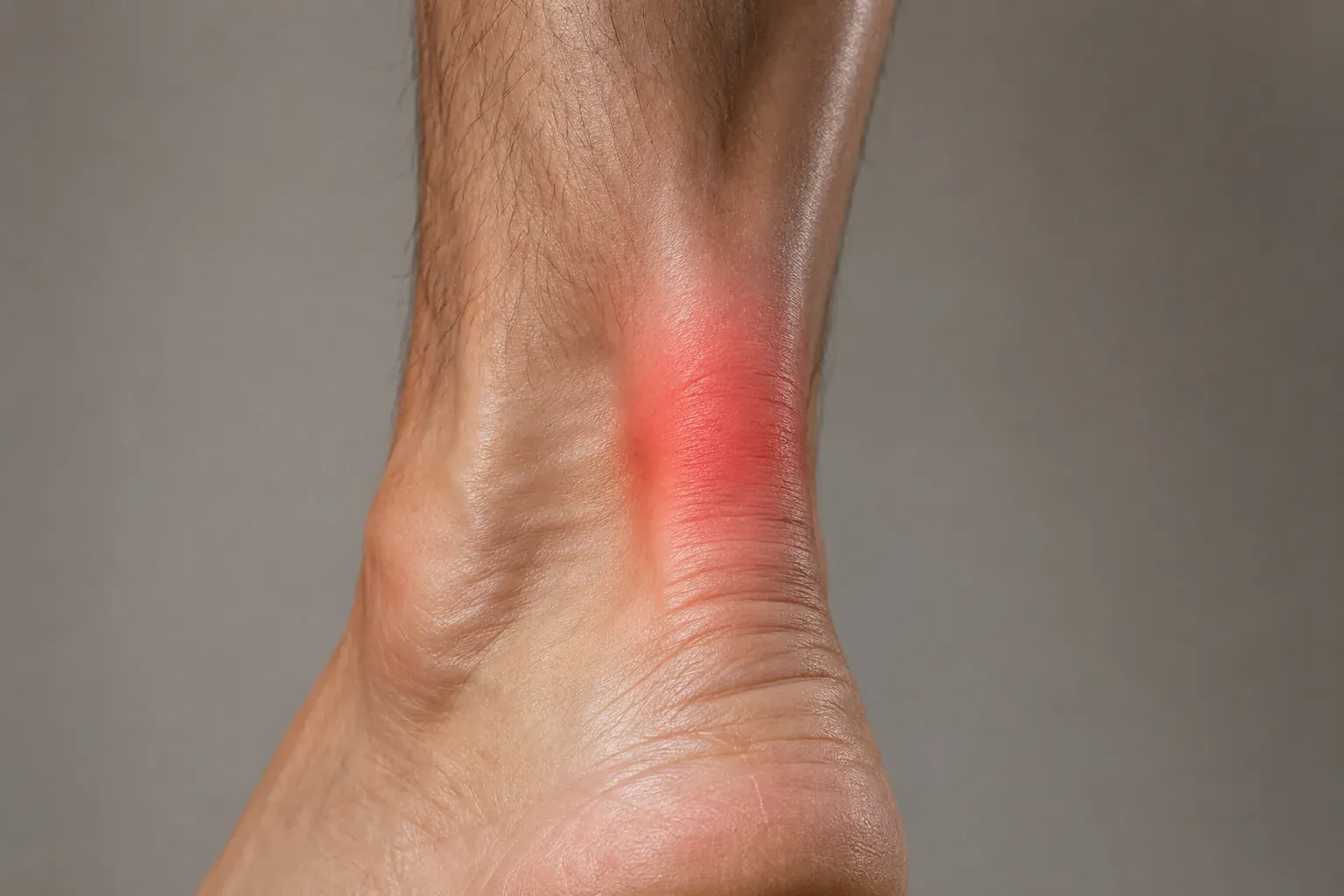
The Achilles connects your calf muscles to your heel bone and transmits the force of every push-off. Tendinitis is overload injury: micro-damage accumulating faster than the tendon's famously slow blood supply can repair it. It comes in two flavors that are treated differently: mid-tendon (a few centimeters above the heel) and insertional (right where the tendon meets the bone).
Dr. Patel locates the damage precisely: mid-tendon or insertional, tendinitis or early tendinosis, and whether the calf or foot mechanics are feeding it. In-office ultrasound shows tendon thickening and any partial tearing, which changes both the plan and the timeline.
Achilles pain that lasts beyond two weeks deserves evaluation, because untreated tendinitis progresses to tendinosis, a degenerated state that takes far longer to fix. Sudden severe pain with a pop is an emergency; that's a rupture until proven otherwise.
Call (281) 494-0572 promptly for: a sudden pop with sharp pain, like being kicked in the heel; inability to push off or stand on tiptoe; significant sudden swelling or bruising at the heel cord. Urgent foot problems are worked into the schedule faster.
Treatment starts with the simplest option likely to work and escalates only when needed.
The gold-standard program: specific heel-drop exercises that rebuild tendon strength, dosed correctly for your type of Achilles problem.
Temporarily reducing tendon stretch lets healing outpace damage while you stay mobile.
Well-supported by evidence for stubborn Achilles pain, especially insertional cases that resist exercise programs.
A walking boot for severe flares; minimally invasive options like Tenex for chronic degenerated tissue. Cortisone is avoided near the Achilles because it raises rupture risk.
Rest alone lets the tendon calm down but doesn't rebuild its capacity, so pain returns when you do. Tendons heal through correctly dosed loading, which is why the exercise program matters more than the rest.
We don't inject cortisone into or around the Achilles; it meaningfully raises the risk of rupture in a tendon you cannot afford to rupture. There are safer effective options, including shockwave.
Recent, mild cases: 6 to 8 weeks with a proper program. Chronic tendinosis: often 3 to 6 months of consistent work. It's slow tissue; the plan works if you work it.
The Achilles heals on tendon time, not your calendar. Knowing the real numbers prevents both premature quitting and reinjury.
Read the article →When heel pain outlasts months of trying, one of four things is usually going on. None of them is 'just live with it.'
Read the article →Plenty of pain-free feet have spurs, and plenty of painful heels don't. Here's how to tell what's actually going on.
Read the article →One visit at our Sugar Land office gets you a diagnosis and a plan. Call (281) 494-0572 or book online.